
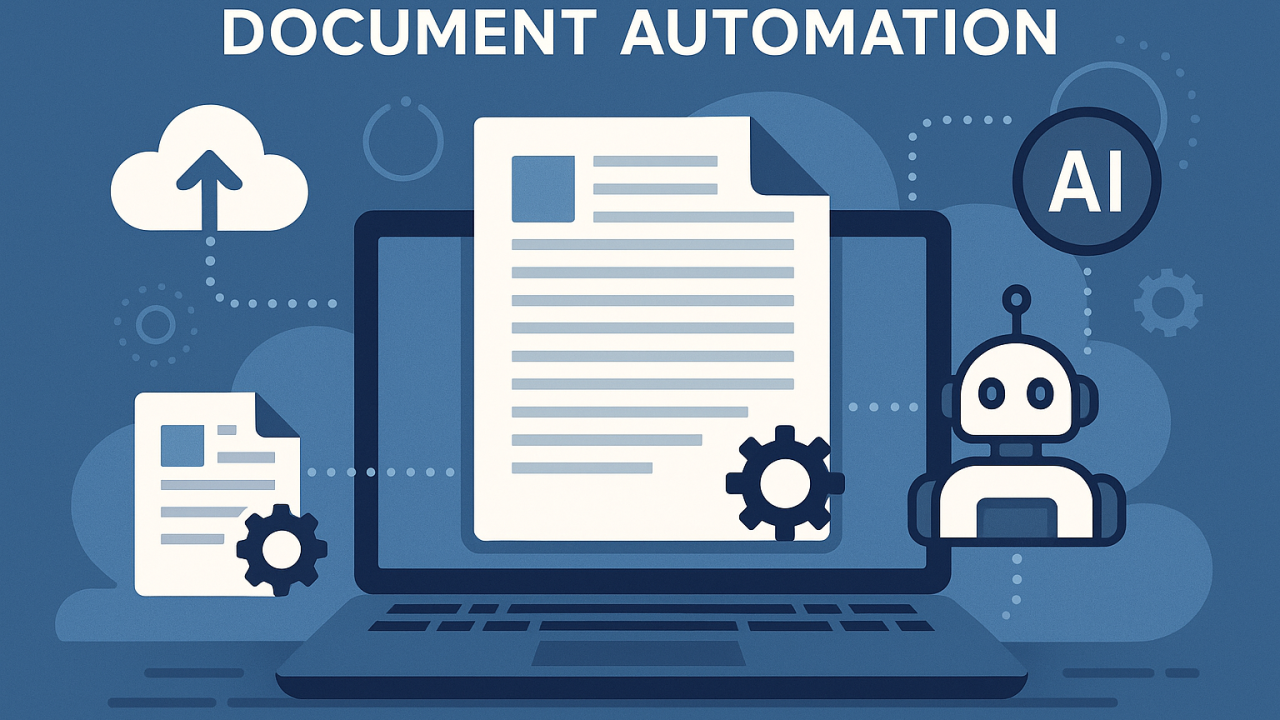
As digital transformation accelerates across industries, document automation has become a critical technology reshaping organizational workflows. This powerful solution is revolutionizing how businesses handle their ever-growing volumes of information while meeting demands for speed and accuracy.
Understanding Document Automation
Document automation uses intelligent software systems to create, process, and manage documents with minimal human intervention. Leveraging artificial intelligence, machine learning, and robotic process automation, this technology streamlines document-centric workflows from creation through storage.
The key distinction between document automation and document management lies in their approach. Document management primarily organizes, stores, and retrieves existing documents, essentially serving as a digital file cabinet. However, document automation actively transforms document creation and processing, acting as an intelligent assistant that generates contracts, extracts invoice data, and automatically routes approvals.
Compelling Benefits
Organizations implementing document automation report transformative results. Error rates in data entry tasks decrease by 95%, while processing times are reduced from hours to minutes. Cost reductions typically range from 30-50% in document processing expenses.
Beyond efficiency gains, automated systems create comprehensive audit trails, enhancing compliance and governance. Customer experience improves dramatically through faster response times and fewer errors in customer-facing documents. Most importantly, staff are freed from repetitive tasks to focus on strategic, value-adding activities.
2025 Trends Reshaping the Landscape
Several key trends define document automation in 2025. Intelligent Document Processing (IDP) now handles unstructured data with remarkable accuracy, understanding context and meaning beyond simple text extraction. Hyper-automation combines multiple technologies to create seamless, end-to-end solutions.
No-code/low-code platforms democratize access, enabling business users to create sophisticated workflows without IT intervention. Generative AI revolutionizes document creation, enabling the drafting of complex documents from minimal inputs while maintaining consistency.
Industry Leadership
Financial services and insurance lead the adoption of automation, streamlining loan processing, claims handling, and compliance. Healthcare organizations streamline patient records, insurance verification, and clinical documentation. Legal firms automate contract generation and review, while manufacturers optimize supply chain documentation and quality control.
Government agencies are increasingly adopting these solutions to improve citizen services and reduce bureaucratic delays, demonstrating the technology’s versatility across sectors.
The Path Forward
Document automation represents more than a technological advancement—it’s a fundamental shift in information management. As AI, machine learning, and process automation converge, the boundaries of possibility continue expanding.
The message for businesses clinging to manual processes is clear: automation isn’t about keeping pace with competitors; it’s about reimagining possibilities when human creativity is unleashed from repetitive tasks. The future belongs to organizations that transform document workflows from operational burdens into strategic assets, turning digital transformation from aspiration into reality.